
Google Launches Gemini 4 Neon: Features, Pricing and How It Compares to ChatGPT
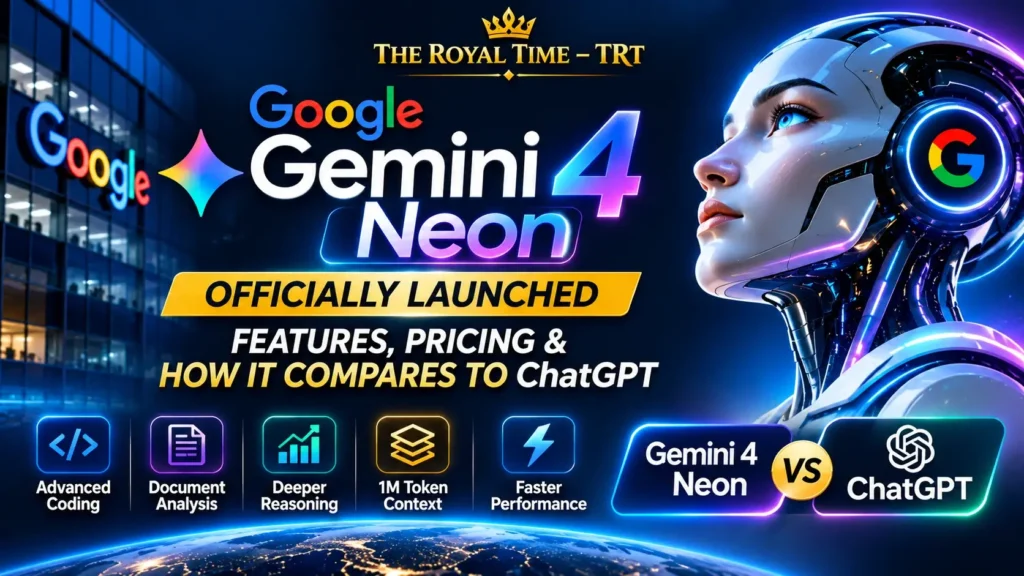
Google has launched Gemini 4 Neon, a new artificial intelligence model that promises advanced reasoning, faster task completion and lower computing costs for complex work.
Announced on November 18, 2026, the model targets developers, businesses, researchers and people who use AI for demanding everyday tasks.
Google says Gemini 4 Neon combines powerful reasoning with efficient performance. It can help users write code, examine business documents, analyze research and complete multi-step assignments.
The launch comes as technology companies compete to build AI systems that can do more than answer questions.
But what makes Gemini 4 Neon different? How much does it cost? And can it compete with OpenAI’s ChatGPT?
Here is everything you need to know.
What Is Google Gemini 4 Neon?
Gemini 4 Neon is a new AI model from Google DeepMind and part of the company’s Gemini 4 family.
Google designed it to offer strong performance across coding, research and professional work without the higher costs that often accompany the largest AI models.
The model can process information from different sources, including documents, spreadsheets, images, audio and video.
It also supports a context window of up to one million tokens.
In simple terms, a large context window allows an AI system to work with substantial amounts of information during one task.
For example, a business could provide several reports, spreadsheets and supporting documents, then ask the model to identify important findings.
Neon aims to understand those materials and produce a useful summary or structured response.
However, a larger context window does not guarantee that the model will interpret every detail correctly.
What’s New in Gemini 4 Neon?
Google introduced several improvements designed to make its latest AI model more useful.
1. Faster Completion of Complex Tasks
Some AI models provide strong answers but take considerable time to complete difficult assignments.
Gemini 4 Neon attempts to balance reasoning quality with speed.
Google reports that Neon offers competitive performance against larger models while completing many tasks more efficiently.
In its early evaluations, the company found that Neon could approach or exceed the quality of Gemini 4 Carbon on certain tasks while operating faster.
Actual performance will depend on the workload, tools and reasoning settings.
2. Better Coding and Software Development
Google has focused heavily on improving Neon’s programming abilities.
The model can examine existing code, identify possible errors, suggest improvements and work across multiple project files.
This makes it potentially useful for developers who need to maintain complicated applications.
For example, a developer could ask Neon to investigate why a feature stopped working after a software update.
The model could review relevant files, suggest a correction and help prepare tests.
However, programmers should still review and test AI-generated changes before deployment.
3. Stronger Research and Document Analysis
Neon can examine detailed reports and combine information from multiple sources.
Businesses may use it to summarize financial documents, compare research findings or prepare structured presentations.
Google also highlights improvements in understanding professional charts and spreadsheets.
These capabilities could save time for analysts, researchers and office workers.
Nevertheless, users should verify important figures and conclusions against their original sources.
4. More Control Over AI Reasoning
Gemini 4 Neon offers four thinking levels that allow users and developers to balance reasoning effort with computing cost.
A simpler task may require less reasoning.
A difficult technical problem may benefit from a higher setting.
This flexibility can help developers choose an appropriate level of performance instead of using maximum computing resources for every request.
Gemini 4 Neon Pricing: How Much Does It Cost?
Google announced the following standard API pricing for Gemini 4 Neon.
| API Usage | Price per 1 Million Tokens |
|---|---|
| Input tokens | $3.00 |
| Cached input tokens | $0.15 |
| Output tokens | $15.00 |
Input tokens represent information sent to the model.
Output tokens represent the information it generates.
Cached input pricing applies when the platform reuses eligible previously processed content under its caching rules.
These prices apply to developer API usage, not monthly subscriptions for the Gemini app.
Businesses that process large amounts of text or run frequent AI tasks should consider both token prices and total workload costs.
A cheaper token rate does not automatically mean a cheaper final result.
The number of steps, tool calls and tokens required to finish a task also matters.
Is Gemini 4 Neon Free?
Google has not introduced Gemini 4 Neon as a universally available free model.
At launch, eligible Google AI Pro and Ultra subscribers can access it through the Gemini app.
Developers can use Neon through the paid Gemini API tier in Google AI Studio.
Google also provides access through supported business and development products.
Users on free plans should not assume that Neon appears in their model selector.
Availability can vary depending on the account, product, region and rollout progress.
How to Access Gemini 4 Neon
Google is introducing the model across several platforms.
Gemini App
Eligible Google AI Pro and Ultra subscribers can open the Gemini app and select Gemini 4 Neon from the model dropdown.
Users should make sure they have access through a supported subscription.
Google AI Studio
Developers can access Neon through the paid Gemini API tier.
This allows them to build AI-powered applications, test prompts and integrate the model into their own software.
The API model identifier is gemini-4-neon.
Google Antigravity
Google is also making Neon available to eligible subscribers through Antigravity, its AI development environment.
The platform supports advanced programming workflows and AI-assisted development tasks.
Gemini for Business
Organizations can access the model through supported business services and API integrations.
This gives teams additional options for analyzing documents, developing software and automating selected workflows.
Gemini 4 Neon vs Gemini 4 Carbon and Hydrogen
Google’s Gemini 4 family includes models that serve different needs.
| Model | Main Purpose |
|---|---|
| Gemini 4 Hydrogen | Fast everyday tasks and general assistance |
| Gemini 4 Neon | Complex reasoning, coding and efficient professional workflows |
| Gemini 4 Carbon | Demanding, long-running projects requiring advanced capabilities |
Hydrogen suits users who prioritize fast responses for common tasks.
Neon offers a balance of reasoning performance, speed and efficiency.
Carbon targets more demanding projects that may require greater computing resources.
The best model depends on the task rather than its position in the product lineup.
Someone drafting a short email may not need the same model as a developer investigating a complicated software problem.
Gemini 4 Neon vs ChatGPT: Which AI Is Better?
Google’s latest announcement naturally invites comparisons with OpenAI’s ChatGPT.
Both companies offer advanced AI models that can assist with research, writing, coding and document analysis.
However, model performance depends on the specific version, application and task.
Coding and Development
Google reports strong results for Neon on several coding evaluations.
The model can work across multiple files and support complicated development workflows.
OpenAI also offers advanced coding capabilities through its models and Codex tools.
Without a controlled, task-by-task comparison, it would be misleading to declare that one platform performs better in every coding situation.
Research and Analysis
Both Gemini and ChatGPT can help users examine information and prepare reports.
Neon supports a one-million-token context window and can process several kinds of content.
The useful comparison is not simply how much information each system accepts.
Accuracy, source quality, reasoning and the ability to follow instructions also matter.
Everyday Productivity
For everyday users, interface design and available tools may matter more than small differences in benchmark scores.
Google’s Gemini ecosystem connects with various Google products.
Meanwhile, ChatGPT offers its own tools and AI-assisted workflows.
The Royal Time previously explored ChatGPT Wallet and how AI agents could change online shopping.
That development reflects a broader industry trend: AI assistants are moving beyond conversations toward completing tasks.
Overall Comparison
Gemini 4 Neon appears particularly attractive for people who want advanced reasoning and efficient execution within Google’s ecosystem.
ChatGPT remains an alternative for users who prefer OpenAI’s models, interface and tools.
Rather than choosing a winner based on marketing claims, businesses should test both platforms against their actual needs.
How Powerful Is Gemini 4 Neon?
Google reports competitive results on several independent AI evaluation platforms.
For example, Gemini 4 Neon achieved a score of 61 on the Artificial Analysis Intelligence Index at its highest thinking setting.
Google says that placed the model third overall at the time of the announcement.
The model also performed strongly in evaluations involving software development, professional tasks and scientific reasoning.
These results suggest that Neon can compete with leading AI systems across several demanding workloads.
However, benchmarks measure performance under specific testing conditions.
They do not guarantee perfect answers or reliable performance in every situation.
Users should examine independent evaluations and their own real-world results before making important purchasing decisions.
Why Does AI Model Efficiency Matter?
Building and operating advanced AI systems requires powerful computing infrastructure.
Companies rely on specialized processors, cloud data centers and substantial electricity supplies to run demanding AI workloads.
As demand grows, developers must consider both performance and operating costs.
A model that completes tasks more efficiently may help businesses reduce unnecessary computing expenses.
The topic also connects to government regulation.
In our earlier coverage, we explained the new US AI chip restrictions and their potential impact on NVIDIA.
These restrictions show how important access to advanced computing technology has become.
Google’s new model reflects another part of the same challenge: making sophisticated AI more practical and affordable to operate.
However, efficiency claims do not automatically establish lower energy use for every application.
Actual consumption depends on hardware, workload and infrastructure.
Can Businesses Trust AI to Complete Complex Work?
AI models are becoming more capable, but organizations still need safeguards.
Neon can support tasks involving documents, code and connected tools.
Google says it has improved the model’s ability to follow instructions and reduce certain types of fabricated results.
The company also reports progress in defending against malicious instructions embedded within external content.
These improvements matter because AI agents may encounter unfamiliar documents, websites and software environments.
Nevertheless, companies should keep human approval in place for important financial, legal and operational decisions.
Teams should also protect sensitive information and review AI-generated work.
The importance of reliable digital infrastructure became clear during the November 2026 Microsoft Outlook and Microsoft 365 outage.
That incident highlighted how businesses can experience disruption when essential technology services become unavailable.
As organizations adopt more AI-powered workflows, contingency planning will remain important.
What Could Gemini 4 Neon Mean for the Future of AI?
Gemini 4 Neon represents a shift toward balancing advanced capabilities with practical operating costs.
Technology companies no longer compete only to produce the strongest model on a benchmark.
They also want AI systems that complete useful work quickly, reliably and at a manageable price.
For businesses, these improvements could make sophisticated AI assistance more accessible.
Developers may gain better tools for software maintenance and application development.
Researchers could benefit from more capable systems for examining technical information.
Everyday users may find that AI assistants can handle increasingly complicated requests.
However, progress will depend on more than model performance.
Privacy, security, accuracy and user trust will continue shaping how organizations adopt AI technology.
Frequently Asked Questions
What is Gemini 4 Neon?
Gemini 4 Neon is an advanced AI model from Google DeepMind that focuses on coding, research and complex professional tasks.
When did Google release Gemini 4 Neon?
Google announced the model on November 18, 2026.
How much does Gemini 4 Neon cost?
The standard API costs $3 per million input tokens and $15 per million output tokens, with discounted cached input pricing.
Is Gemini 4 Neon available in the United States?
Yes. Google began rolling it out to eligible US users and developers through supported Gemini products.
Can I use Gemini 4 Neon for free?
Google initially provides Neon through paid plans and supported paid API access, rather than unrestricted free access.
Is Gemini 4 Neon better than ChatGPT?
It depends on the task and which ChatGPT model you compare it against. Both platforms offer powerful capabilities, but no single model leads in every situation.
Does Gemini 4 Neon support coding?
Yes. Google designed it to handle advanced programming, debugging and complex software development workflows.
What makes Gemini 4 Neon different?
Its main strengths include advanced reasoning, a one-million-token context window, coding capabilities and a balance between performance and cost.
Final Thoughts
Google Gemini 4 Neon is another significant development in the rapidly evolving artificial intelligence industry.
The model combines advanced reasoning, strong coding capabilities and support for complex business workflows.
Google also aims to make these capabilities available at a more practical operating cost than some larger AI systems.
For developers, Neon provides another tool for building applications and solving difficult technical problems.
For businesses, it offers potential improvements in document analysis, productivity and automation.
For everyday users, the launch brings another option for completing complicated tasks with AI.
The competition between Google, OpenAI and other AI companies will continue to accelerate innovation.
But ultimately, users will judge these systems by how well they perform in real situations.
The future of artificial intelligence is not just about building smarter models. It is about making those models useful, reliable and affordable for more people.
The Royal Time – TRT
Truth. Technology. Trends.