
Adolf Hitler: How He Took Power and Led Germany Into World War II
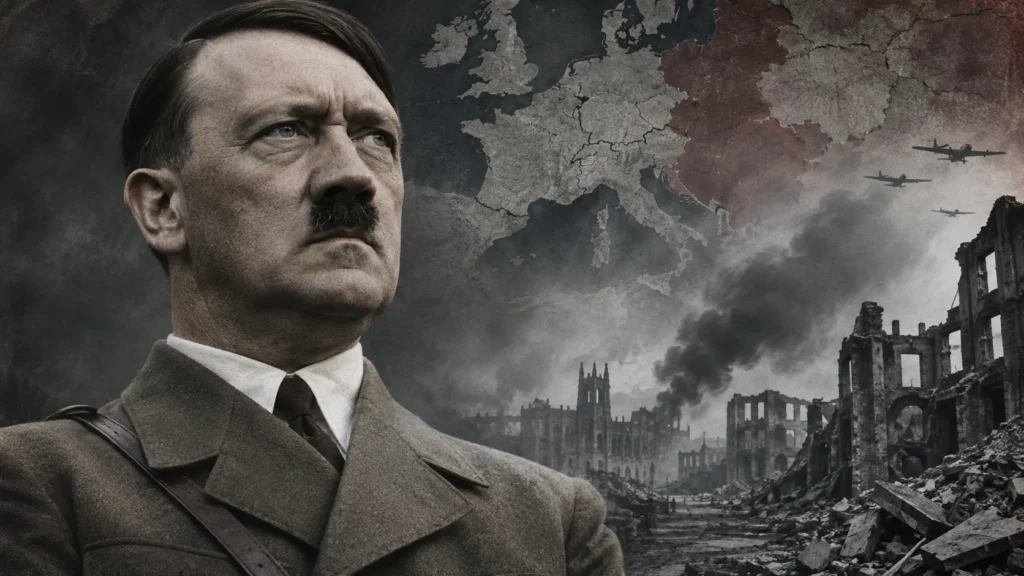
Adolf Hitler led Germany from 1933 until 1945. He promised to restore national pride after World War I, but his rule brought dictatorship, persecution, another world war and the murder of millions of people.
Hitler’s early years
Hitler was born on 20 April 1889 in Austria. As a young man, he lived in Vienna and later moved to Germany. He served in the German army during World War I.
Germany’s defeat in 1918 deeply affected him. Like many people, he was angry about the peace settlement and the country’s economic problems. But he took those feelings in a dangerous direction, blaming Jewish people and other groups for Germany’s difficulties.
These ideas became central to his politics. They were false and rooted in prejudice, not evidence.
The Nazi Party and a failed takeover
After the war, Hitler joined a small political movement that became the Nazi Party. He was a skilled public speaker and used emotional speeches to attract supporters. Nazi propaganda promised a strong Germany while attacking democracy, political opponents and Jewish communities.
In November 1923, Hitler and his followers tried to take power by force in Munich. The attempt failed. Hitler was arrested and sent to prison, where he worked on his book Mein Kampf.
How did Hitler become Germany’s leader?
The Great Depression began in 1929 and hit Germany hard. Many people lost their jobs and savings.
The Nazis took advantage of this crisis. Their support grew, but they never won a majority of the popular vote in a free national election.
On 30 January 1933, President Paul von Hindenburg appointed Hitler chancellor. Conservative political figures believed they could control him. They were badly mistaken.
After the Reichstag fire in February, the Nazi government restricted freedoms and arrested opponents. The Enabling Act of March 1933 allowed the government to make laws without normal parliamentary approval. Within months, rival political parties were pushed out of public life.
When Hindenburg died in 1934, Hitler combined the country’s top offices and became its dictator.
Life under Nazi rule
The Nazis controlled newspapers, radio, schools and many cultural institutions. Political criticism became dangerous. People who opposed the regime could be arrested and sent to concentration camps.
The government also built its policies around racist beliefs. Jewish people were gradually stripped of their rights, jobs and citizenship. The Nuremberg Laws of 1935 were a major step in this process.
Other groups, including Roma and Sinti people, disabled people, political opponents and gay men, also faced persecution.
How World War II began
Hitler wanted to expand German territory. In September 1939, Germany invaded Poland. Britain and France declared war on Germany, and World War II began in Europe.
German forces conquered or occupied large parts of Europe. In June 1941, Hitler invaded the Soviet Union. The war spread across enormous distances and caused terrible losses on all sides.
Meanwhile, the Nazi regime carried out the Holocaust: the systematic murder of six million European Jews. Millions of other people were also killed through Nazi persecution and wartime crimes. These crimes are central to understanding Hitler’s rule, not a small part of the story.
The fall of Nazi Germany
By 1944 and early 1945, Germany was losing the war. Allied forces advanced from the west, while Soviet forces approached Berlin from the east. Cities were destroyed, and many civilians were forced to flee.
Hitler stayed in Berlin as Soviet troops closed in. He died by suicide on 30 April 1945. Germany surrendered in May, ending the war in Europe.
The end of the war revealed the full scale of Nazi crimes. Survivors’ testimony, documents and physical evidence helped the world understand what had happened.
Why Hitler’s history still matters
Hitler did not seize power alone. Political deals, economic fear, propaganda, violence and the actions of many supporters helped him rise. Once in office, he weakened democratic institutions until almost no checks on his power remained.
His story is a warning about racism, hatred and the damage caused when leaders are allowed to place themselves above the law.
How Did Hitler Rise to Power in Germany?
Adolf Hitler’s rise to power was the result of political instability, economic hardship, extremist propaganda and the weakening of Germany’s democratic institutions.
After the First World War, Germany faced serious economic and political difficulties. The Great Depression of 1929 created further unemployment and public frustration, which the Nazi Party exploited to gain support.
Hitler used mass rallies, nationalist messaging, antisemitic conspiracy theories and promises of national recovery to expand the Nazi movement.
How Did Hitler Come to Power?
On January 30, 1933, President Paul von Hindenburg appointed Adolf Hitler as Germany’s chancellor. Hitler did not become dictator through a single direct national vote.
After the Reichstag Fire, the Nazi government restricted civil liberties and targeted political opponents. The Enabling Act of March 1933 then allowed Hitler’s government to legislate without normal parliamentary approval, helping destroy Germany’s democratic system.
Why Was Adolf Hitler Important in World History?
Adolf Hitler played a central role in the outbreak of the Second World War in Europe and the Nazi regime’s genocide of six million Jews, alongside the persecution and murder of millions of other victims.
His dictatorship demonstrates the devastating consequences of extremist ideology, political repression, aggressive expansionism and the collapse of democratic safeguards.
Frequently asked questions
When did Hitler become chancellor?
He was appointed German chancellor on 30 January 1933.
Did Hitler win a majority of German votes?
No. The Nazi Party never won an outright majority in a free national election before Hitler was appointed chancellor.
How did Hitler die?
He died by suicide in Berlin on 30 April 1945.
Sources and further reading
- United States Holocaust Memorial Museum, Nazi Rise to Power: https://encyclopedia.ushmm.org/content/en/article/the-nazi-rise-to-power
- United States Holocaust Memorial Museum, Adolf Hitler: https://encyclopedia.ushmm.org/content/en/article/adolf-hitler

