

NASA’s Voyager 1 Reaches One Light-Day From Earth – But There’s a Problem
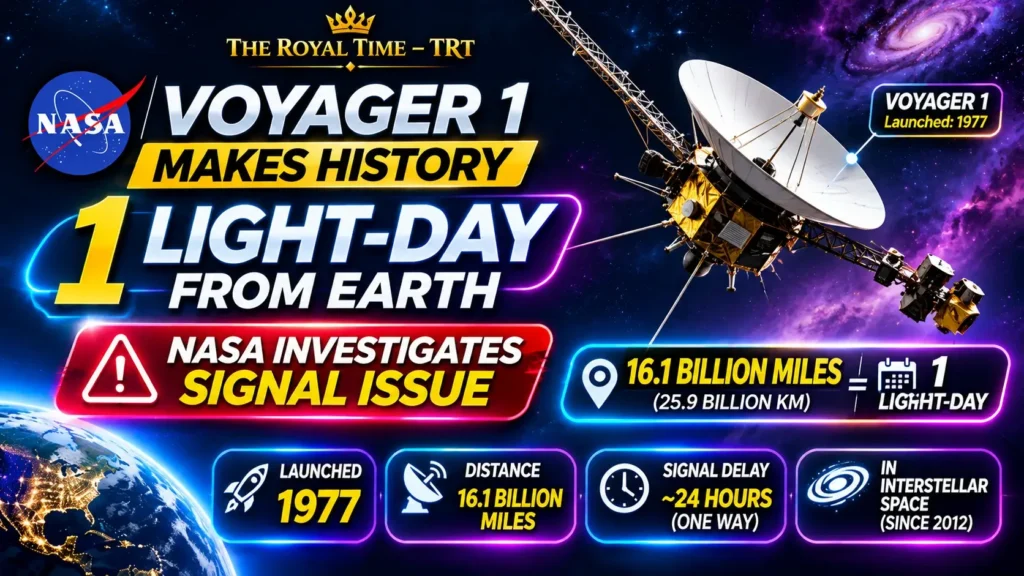
NASA’s Voyager 1 has achieved something no spacecraft has ever accomplished before: reaching a distance of one light-day from Earth.
On November 18, 2026, the historic spacecraft crossed a remarkable milestone, traveling approximately 16.1 billion miles (25.9 billion kilometers) from our planet.
Voyager 1 launched in 1977, nearly five decades ago. Since then, it has explored distant planets, entered interstellar space and continued traveling farther from Earth.
But the historic achievement comes with a worrying development.
NASA engineers are investigating a problem that has prevented Voyager 1 from returning science and engineering data since November 14.
The spacecraft continues to transmit a radio carrier signal, but its normal data transmissions have stopped.
So how far away is Voyager 1? What does one light-day mean? And could the latest technical problem threaten its extraordinary mission?
Here is what NASA has confirmed.
Voyager 1 Becomes the First Spacecraft One Light-Day From Earth
On November 18, 2026, at approximately 5:16 a.m. Eastern Time, Voyager 1 reached one light-day from Earth.
NASA confirmed the milestone in an announcement published on November 19.
At that distance, even light traveling at approximately 186,000 miles per second needs a full day to reach the spacecraft from our planet.
Voyager 1 has traveled farther than any other human-made object.
The achievement is particularly impressive because NASA originally designed the probe to explore Jupiter and Saturn.
Instead, it continued its journey for more than 49 years.
Today, the spacecraft travels through interstellar space, a region beyond the protective bubble created by the Sun’s solar wind.
Its latest milestone highlights both the enormous distances involved in space exploration and the endurance of NASA’s engineering.
What Does One Light-Day Actually Mean?
A light-day measures distance, not the time a spacecraft spends traveling.
It represents how far light travels in 24 hours.
Because light moves incredibly fast, that distance equals approximately 16.1 billion miles.
Voyager 1 needed more than 49 years to reach a destination that light could reach in just one day.
That difference reveals the extraordinary scale of space.
For perspective, sunlight normally reaches Earth in about eight minutes.
A radio signal traveling between Earth and Voyager 1 now requires approximately 24 hours in one direction.
That means a complete message-and-reply exchange takes roughly 48 hours, even before NASA engineers spend time processing or responding to the information.
The delay makes spacecraft operations increasingly complicated.
Mission controllers cannot steer Voyager 1 as if they were remotely operating a vehicle in real time.
Instead, they must plan commands carefully and wait for the results.
NASA Is Investigating a New Voyager 1 Data Problem
While NASA celebrated the distance record, engineers were also investigating an unexpected communications issue.
According to the agency, the Voyager mission team discovered the problem on November 14.
A Deep Space Network antenna in Canberra, Australia, detected Voyager 1’s radio carrier signal.
However, the signal did not contain the expected science and engineering data.
A carrier signal normally helps transport information from the spacecraft to Earth.
Receiving that signal indicates that the spacecraft is still transmitting radio energy.
But without the expected data, engineers cannot examine its normal telemetry or scientific measurements in the usual way.
In its November 19 announcement, NASA confirmed that the spacecraft continued transmitting the carrier signal while the team investigated the missing information.
Importantly, NASA has not declared Voyager 1 lost.
The cause of the latest data interruption remains under investigation in the agency’s published update.
How Did NASA Confirm the Distance Without Normal Data?
The missing science and engineering data created an unusual challenge.
Fortunately, the mission team already had detailed information about Voyager 1’s trajectory.
Engineers use spacecraft tracking, radio measurements and established flight calculations to estimate its location.
NASA explained that it could confirm the light-day milestone through the received carrier signal and trajectory calculations.
The spacecraft did not need to send a new photograph or a special message announcing the achievement.
Its position followed from decades of navigation and tracking.
That distinction matters because the distance record remains valid even while the team works to restore the normal data stream.
Voyager 1’s Incredible Journey Since 1977
NASA launched Voyager 1 on September 5, 1977, from Cape Canaveral, Florida.
The original mission focused on studying Jupiter and Saturn.
Voyager 1 reached Jupiter in March 1979 and Saturn in November 1980.
Its observations transformed scientists’ understanding of the outer solar system.
The spacecraft collected important information about planetary atmospheres, magnetic fields, rings and moons.
A close encounter with Saturn’s moon Titan also helped shape Voyager 1’s outward path.
After completing its main planetary encounters, NASA extended the mission.
Voyager 1 continued traveling away from the Sun and eventually entered interstellar space in August 2012.
That transition marked another historic achievement.
It became the first spacecraft to cross the heliopause, the boundary where the Sun’s solar wind gives way to the surrounding interstellar environment.
However, entering interstellar space does not mean the spacecraft has escaped every part of the solar system in the broadest gravitational sense.
The distant Oort Cloud, for example, extends far beyond its current position.
Why Is Voyager 1 Still Important to Science?
Voyager 1 provides scientists with an opportunity they cannot easily reproduce.
It has traveled beyond the heliosphere, allowing its instruments to investigate conditions in interstellar space directly.
Scientists study particles, magnetic fields and other properties of this distant environment.
These observations help researchers understand how the Sun interacts with the material surrounding our solar system.
The spacecraft also provides valuable information about the challenges of operating scientific equipment over enormous distances.
Every functioning instrument represents a remarkable achievement in engineering.
NASA continues working to preserve the spacecraft’s remaining scientific capabilities.
However, the current data interruption means the team cannot receive its normal measurements until the issue is resolved.
How Does NASA Communicate With Voyager 1?
NASA relies on the Deep Space Network to communicate with distant spacecraft.
This international system includes major antenna complexes in California, Spain and Australia.
Together, they help NASA maintain contact with spacecraft as Earth rotates.
Voyager 1 sends extremely weak radio signals across billions of miles.
Large ground antennas detect those signals and pass the information to mission teams.
The enormous distance creates several challenges.
Signals weaken during their journey, communication takes considerable time and engineers must carefully manage limited spacecraft power.
A command sent today will not reach Voyager 1 until roughly the following day.
Even if the spacecraft responds immediately, the reply needs another day to return.
That delay makes troubleshooting difficult.
NASA engineers must often wait nearly two days to see the result of a command.
Voyager 1 Is Running Out of Power
Distance isn’t the only challenge facing Voyager 1.
The spacecraft also has a limited power supply.
Unlike many spacecraft operating closer to Earth, Voyager 1 cannot depend on ordinary solar panels for sufficient electricity.
Instead, it uses radioisotope thermoelectric generators.
These devices convert heat from the natural decay of radioactive material into electrical energy.
Over time, the available power gradually declines.
NASA estimates that the Voyager spacecraft lose approximately four watts of electrical power each year.
To extend the mission, engineers have turned off unnecessary equipment and developed creative ways to conserve energy.
In September 2026, the team completed a special power-saving operation that replaced three active devices with lower-power alternatives.
The engineers nicknamed this operation the Big Bang.
NASA reported that the change could help the spacecraft keep its remaining science instruments operating longer than previously expected.
The latest data problem is separate from that planned power-saving operation, and NASA has not established a definitive cause for the interruption.
Is Voyager 1 Still Working?
As of NASA’s November 19, 2026 announcement, Voyager 1 was still transmitting a radio carrier signal.
However, the mission team had not received normal science and engineering data since November 14.
That means the spacecraft had not completely disappeared from NASA’s radio tracking.
The agency was investigating the issue.
This isn’t the first time the aging probe has experienced communications difficulties.
In October 2026, NASA temporarily lost radio contact with Voyager 1 before its signal returned.
Engineers have also worked through earlier spacecraft data problems during the mission.
Those recoveries offer reasons for cautious optimism, but they do not guarantee that the latest issue will be resolved.
For now, the important distinction is between losing normal data and losing all contact.
What Is the Voyager Golden Record?
Voyager 1 carries more than scientific instruments.
It also carries a Golden Record designed to represent life and culture on Earth.
The record contains selected sounds, music, greetings and images intended to communicate something about humanity and our planet.
A committee led by astronomer Carl Sagan helped select the material.
NASA included the record as a symbolic message for any distant civilization that might someday encounter the spacecraft.
There is no evidence that extraterrestrial life has discovered it.
In fact, the chances of such an encounter are extremely uncertain.
Nevertheless, the Golden Record remains one of the most memorable symbols of human curiosity.
It represents the idea that space exploration is about more than collecting measurements.
It also reflects humanity’s desire to understand the universe and share something about our existence.
How Does Voyager 1 Compare With Modern Space Missions?
Modern spacecraft often rely on far more advanced computers, sensors and communication systems than engineers had available in 1977.
However, Voyager 1 has something most modern missions cannot match: distance.
Its nearly 50-year journey has carried it well beyond the outer planets.
Meanwhile, newer missions continue exploring the solar system through different technologies.
For example, our earlier coverage of SpaceX’s historic Starship tower catch explains advances in recovering spacecraft after orbital missions.
Reusable rockets may eventually make certain types of spaceflight more economical.
Voyager 1 represents a very different engineering achievement: keeping a robotic explorer operating across decades and billions of miles.
Another important mission is the European Space Agency’s Hera spacecraft.
Our report on the Hera mission’s investigation of NASA’s asteroid impact explains how researchers are studying techniques that could help protect Earth from dangerous asteroids.
Together, these missions show the wide range of questions that space exploration seeks to answer.
When Will Voyager 2 Reach One Light-Day?
Voyager 1 has a twin spacecraft, Voyager 2.
NASA launched Voyager 2 on August 20, 1977, several weeks before Voyager 1.
Despite launching first, Voyager 2 followed a different route through the solar system.
It visited Jupiter, Saturn, Uranus and Neptune.
Voyager 2 entered interstellar space in 2018.
According to NASA’s current estimates, Voyager 2 could reach one light-day from Earth in November 2035.
That means Voyager 1 currently holds the distance record and is expected to keep it.
The two spacecraft continue providing valuable lessons about operating beyond the outer planets, even as their aging systems face growing limitations.
What Happens Next for Voyager 1?
NASA’s immediate challenge is understanding the latest data interruption.
Engineers need to determine why the spacecraft’s carrier signal is reaching Earth without the expected science and engineering information.
The mission’s distance means every troubleshooting attempt requires careful planning.
A single command-and-response cycle can take approximately two days.
At the same time, engineers must protect the probe’s limited electrical power.
Even if NASA restores normal data transmissions, the spacecraft will continue aging.
Its available energy will decline, and the mission team will eventually need to turn off additional equipment.
However, Voyager 1 will keep traveling through space long after its instruments stop operating.
Its journey represents one of humanity’s most extraordinary accomplishments in robotic exploration.
Frequently Asked Questions
How far is Voyager 1 from Earth in 2026?
Voyager 1 reached approximately 16.1 billion miles, or 25.9 billion kilometers, from Earth on November 18, 2026.
What does one light-day mean?
A light-day is the distance light travels in 24 hours, approximately 16.1 billion miles.
Is Voyager 1 still sending signals to Earth?
NASA reported on November 19 that it was receiving a carrier signal, although normal science and engineering data had stopped.
Has NASA lost contact with Voyager 1?
NASA had not lost all radio contact in its latest published update. Engineers were investigating the missing data transmissions.
How long does it take to communicate with Voyager 1?
A signal takes about 24 hours each way, making the minimum round-trip communication time approximately 48 hours.
When did Voyager 1 launch?
NASA launched Voyager 1 on September 5, 1977.
Is Voyager 1 outside the solar system?
Voyager 1 entered interstellar space in 2012 after crossing the heliopause, but it has not passed beyond every possible boundary of the Sun’s wider gravitational domain.
When will Voyager 2 reach one light-day?
NASA estimates that Voyager 2 could reach the milestone in November 2035.
Final Thoughts
Voyager 1 reaching one light-day from Earth marks a historic achievement in space exploration.
After more than 49 years, NASA’s spacecraft has traveled farther than any other human-made object.
The milestone also highlights the extraordinary distances involved in exploring the universe.
A radio signal now needs an entire day to travel between Earth and Voyager 1.
Meanwhile, NASA engineers face another challenge as they investigate the interruption affecting the spacecraft’s science and engineering data.
The outcome remains uncertain, but the mission has already transformed humanity’s understanding of the outer solar system and interstellar space.
Even when Voyager 1 eventually stops sending signals, its journey will continue.
Nearly 50 years after launch, humanity’s most distant explorer is still making history.
The Royal Time – TRT
Truth. Technology. Trends.


